



WAIC 2026 showed China’s bid to build an AI-native future—with agents, robots and domestic computing at home, and a new global governance bloc abroad.
WAIC 2026: Key takeaways
- China’s AI industry is moving beyond model launches and towards agents, devices and robots designed to complete real tasks.
- AI-agent smartphones could place agents between brands and consumers.
- Domestic computing and AI diplomacy are becoming part of the same commercial story.
The World AI Conference (WAIC) is a stage for a technology that’s shaping business – and our very lives – in dramatic ways. This year’s edition has given us plenty to mull over.
Agent-based smartphones played a big role this year
More than 300 robots occupied the halls alongside giant computing clusters, hundreds of product launches, and Xi Jinping himself delivered the keynote speech. Amid all this spectacle, the tone of the event was easy to pick up: China’s AI industry wants to move beyond what models can generate towards what AI can actually do.
Across smartphones, pharmacies and service platforms, exhibitors offered an early view of an AI-native consumer economy, with agents as the interface, robots as the workforce and domestic computing as the foundation. Here’s how.
Agents move into consumers’ pockets
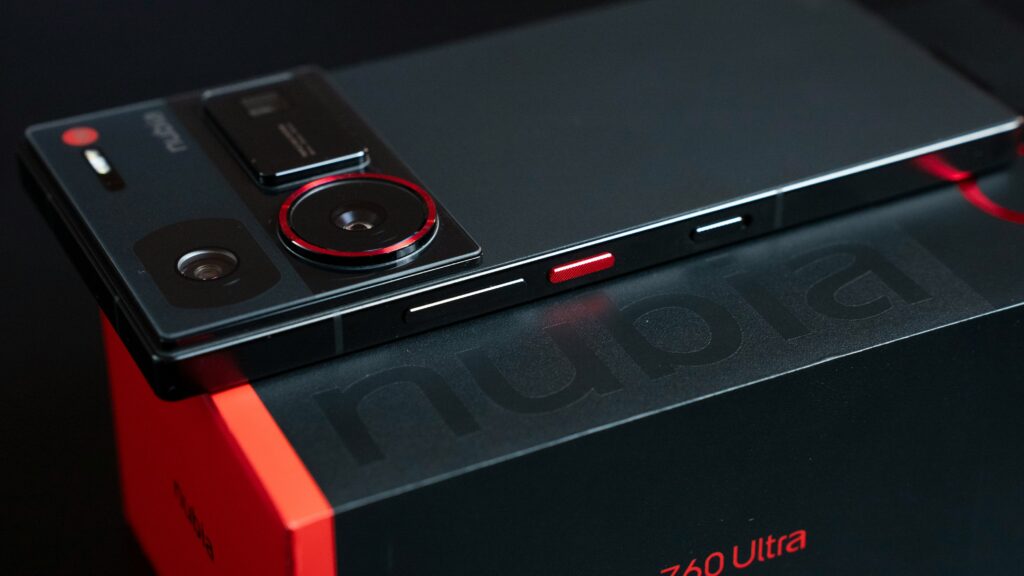
Manufacturers presented agent-centred smartphones as the future for how we interact with our phones. By doing so, the smartphone became one of WAIC’s key battlegrounds.
ZTE-owned Nubia used WAIC to unveil the NaviX Ultra, which it calls the world’s first mass-produced, system-level AI-agent phone. Powered by ByteDance’s Doubao assistant, it is designed to interpret intent and coordinate tasks across apps rather than simply answer questions.
Other manufacturers showed similar devices, which work a bit like this: if you were, say, preparing for a business trip, you could ask the phone to gather travel information, organise documents and set reminders without moving manually between apps and services.
WAIC 2026 was China’s clearest attempt yet to make an AI-native economy visible.
This is big news. If agents compare products, make bookings and arrange after-sales support, they become intermediaries between companies and customers. That’s got huge implications for brands: under an agent system, visibility will depend on whether a brand’s services can be understood and used by your smartphone’s AI agent instead of whether its advertising attracts a human’s click.
Robots clock in


Last year the robots at WAIC were judged on their ability to run, box and dance. This year the tests were far more practical. More than 200 embodied-AI companies demonstrated the ability to perform stable, repeatable work in real-world contexts.
Ant Group subsidiary, Robbyant, provided a clear example. Its smart-pharmacy display used three differently shaped robots, controlled by a shared ‘brain’, to receive an order, retrieve medicine and deliver it. A version is already operating in a Guoda Drugstore in Shanghai.
This turns embodied AI from exhibition theatre into a labour story. The immediate opportunity is robots handling narrow, repetitive tasks in pharmacies, factories, hotels, and logistics, then gradually expanding what they can do.
Domestic computing takes centre stage

Huawei displayed its Atlas 950 SuperPoD. This system connects large numbers of its own AI chips so they can work together like one giant computer. Sugon unveiled another enormous system built using 100,000 domestically produced AI processors.
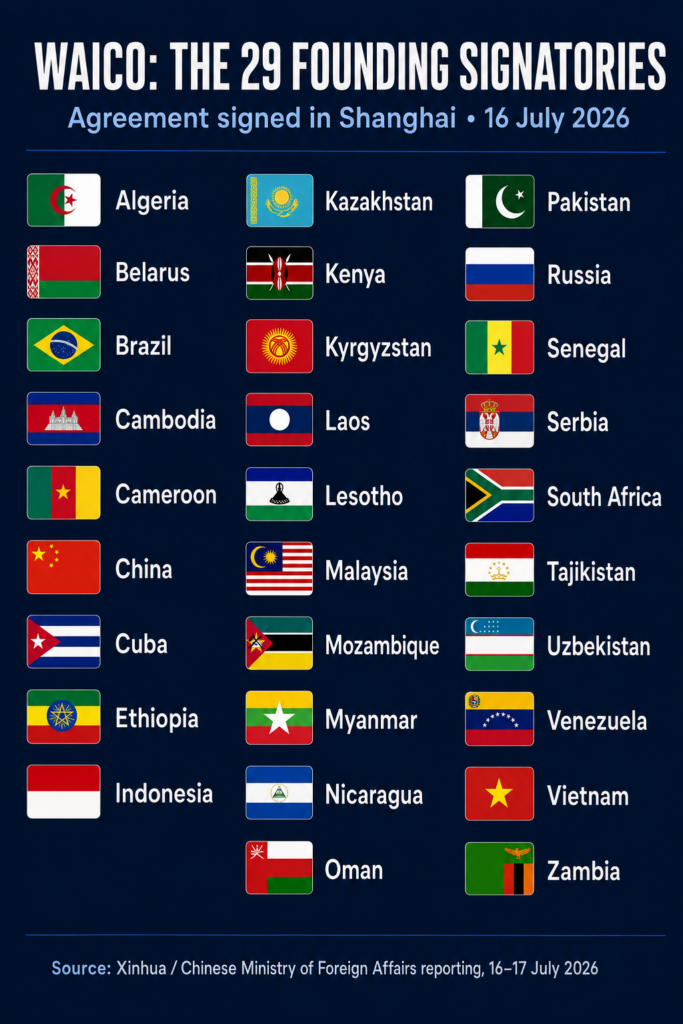
Diplomacy was another area to watch, with China uniting 29 nations to sign the founding agreement for the Shanghai-based World Artificial Intelligence Cooperation Organisation
This doesn’t mean China can yet match the world’s most advanced chips, but it does show how Chinese companies are working around restrictions by combining domestic hardware to create the computing power needed to run AI. In short, China is turning technological self-reliance from a political goal into something businesses can buy and use.
A shop window and diplomatic stage
WAIC passed 100,000 square metres for the first time, bringing together more than 1,100 companies, 3,000 exhibits and over 300 global product debuts. Chips, models, agents, devices, and robots appeared as parts of one ecosystem.
Politically, the most notable moment came when representatives from 29 countries signed the founding agreement for the Shanghai-based World Artificial Intelligence Cooperation Organisation. The agreement established a new intergovernmental body intended to coordinate cooperation on AI development, governance rules, and technical standards.
The Dao view: WAIC 2026 gave us practical uses for AI
Last year much of the event’s hype came from the dancing robots. This year we got a different look at things. WAIC 2026 was China’s clearest attempt yet to make an AI-native economy visible. Robots supplied the spectacle. Agents provided the commercial idea. That is, AI as the layer through which consumers ask, choose and buy. Domestic computing supplied the industrial base. The question after Shanghai is how quickly this connected stack can become ordinary life.