




Duolingo China growth strategy: Key takeaways
- Duolingo has turned Duo into a Chinese internet celebrity, making the mascot attractive to brands seeking culturally relevant online attention
- Story-led collaborations offer the brand a number of opportunities
- Constant escalation risks exhausting the format.
Duolingo’s (多邻国) mascot, Duo, has lived quite the life in China. He’s married Luckin Coffee’s deer, stolen a McDonald’s spatula, become a Meituan delivery rider, played drunken chess at a Shanghai bar.
These partnerships are frames of a bigger plan. They turn the language-learning mascot into an internet celebrity, then using partner brands to carry it offline. The impressions these campaigns land will show you why it’s an online-to-offline trick worth studying.
Building a Chinese internet personality


This collaboration machine works because Duolingo first gave Duo a recognisable personality. Social media comes first. There, Duo behaves like a chaotic content creator. She’s anything she needs to be to garner attention, and it doesn’t always have to be positive.
The mascot has been romantically needy, jealous, threatening, embroiled in crime. The most important consideration is reach, and what might travel well online. Return on investment with this strategy is stunning.
A relatively inexpensive appearance at GQ China’s Creative Awards – where Duo attended dressed in a Chun-Li-inspired outfit – generated around 25 million impressions from an activation valued at RMB 15,000 (US $2,100).
Collaborations like this did not create Duo’s popularity from nothing
Collaborations like this did not create Duo’s popularity from nothing. They became possible because Duolingo had already made the owl a cultural touchstone. In a sense, what Duolingo had done was give their mascot a celebrity profile. After a few forays into social media, Duo had as much life as living, breathing person.
Making advertising episodic

China’s collaboration market is overcrowded. To cut through, Duolingo treats each partnership as an episode in an expanding character universe rather than a one-off product launch.
First comes a plot. Weddings, thefts, resignation, defection. Products follow as consequences of the story. Luckin’s drinks became Duo’s ‘children’, McDonald’s missing spatula became merchandise, and Meituan orders became the owl’s career change.


This creates several social moments from one collaboration. Audiences follow clues and speculate in comments sections. The reveal is withheld. Brands have a longer collaboration window to expand the story’s reach.
It’s also worth pointing out that in this collaboration format, partners borrow more than a mascot. They receive a role within Duolingo’s world. The advertisement becomes something consumers follow before they know what they are being sold. And shut us down if it’s not refreshing to see two brands collaborating on something deeper than a logo swap.
Borrowing a physical footprint
_来自小红书网页版-1-769x1024.jpg)
Partnerships solve a practical problem for Duolingo. As a digital subscription app, it has no natural physical presence. Collaborations with brands like Luckin and McDonald’s provide stores, cups, packaging and mass consumption.
One very genius link up saw Duolingo print odd bilingual phrases on the toilet paper at WeWork branches. The idea was that people supposedly spend around 14 minutes a day on the toilet, so even bathroom time could be an opportunity for a short language lesson.
Duolingo reported a 30% month-on-month increase in new Chinese users during the 2025 Luckin launch
MINISO represents the model’s most commercial China extension. Its range of more than 70 Duolingo products – plush toys, stationery, clothing, blind boxes – allowed the company to monetise character recognition outside of app subscriptions.

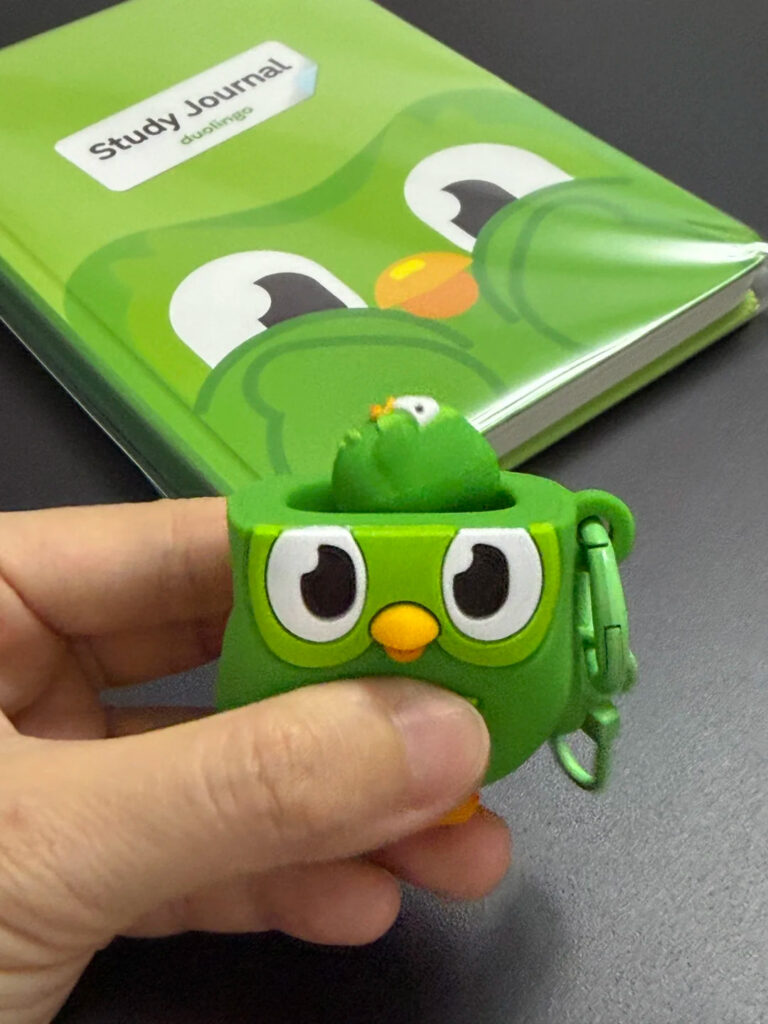
The results suggest attention turns into acquisition. Duolingo reported a 30% month-on-month increase in new Chinese users during the 2025 Luckin launch. Luckin reportedly sold more than nine million collaborative drinks in the first week. And all of this giving Duolingo a temporary physical network without requiring it to build stores or communities itself.
From mascot to consumer IP
China is becoming a laboratory for a broader Duolingo business, one where Duo shifts from advertising device to licensable intellectual property. Other ideas have also travelled outwards.
After beginning in China, the Luckin relationship expanded into the US in 2026. Duolingo CEO Luis von Ahn has said Chinese brands’ willingness to move quickly makes the market particularly suited to collaboration experiments. He’s not wrong. The metrics of this strategy show it works, but we’d add a note of caution.
Once the mascot has staged a wedding, committed a crime and changed careers, every new campaign needs an even stranger premise. Branding requires carefully crafted stories, and novelty wears off quick in China’s collaboration market. Stretch the narrative limits of this strategy too far and your collaboration product becomes yet another object on which to print a green owl.