


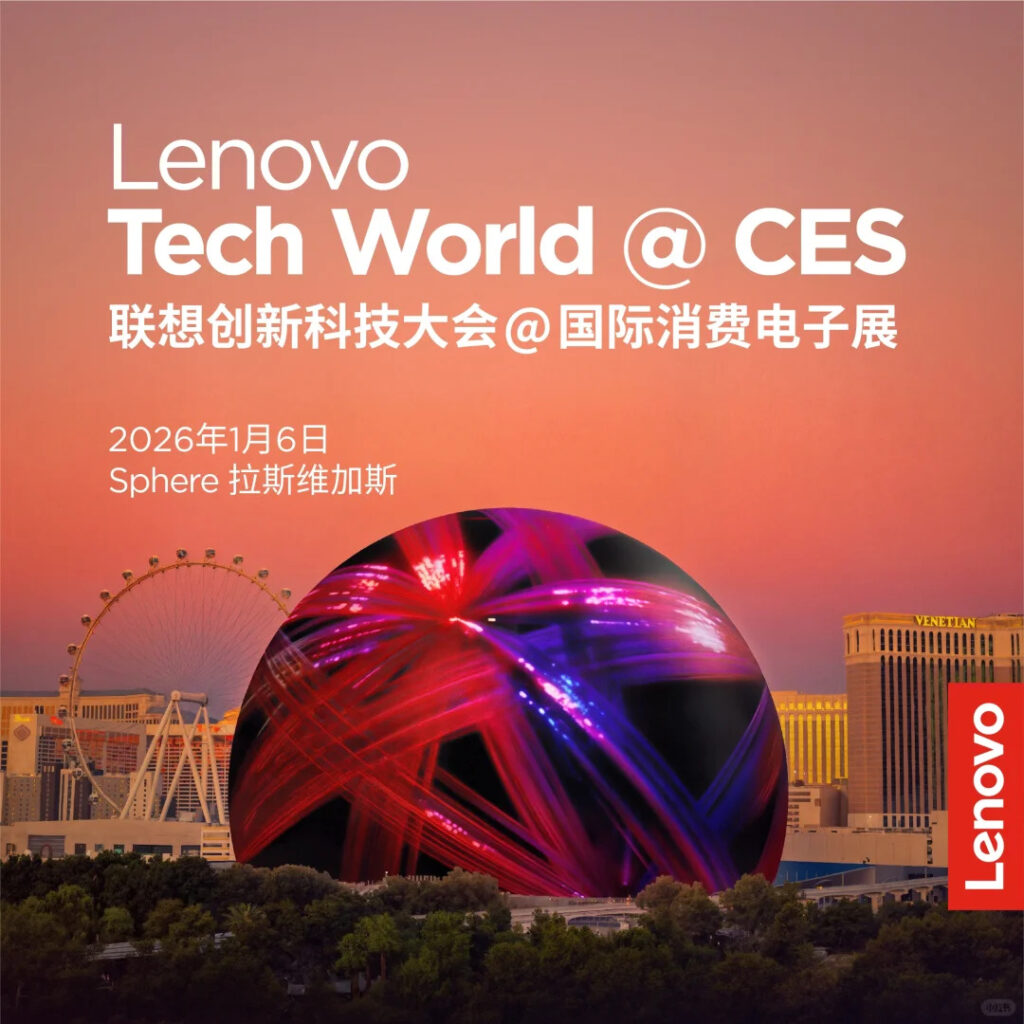
At the 2026 Consumer Electronics Show (CES 2026), Lenovo Group (联想集团) and Nvidia announced an expanded partnership to build what they describe as an enterprise AI cloud super factory – a system designed to support large-scale AI training and deployment at speed.
Unveiled by Lenovo chairman and CEO Yang Yuanqing (杨元庆) alongside Nvidia founder and CEO Jensen Huang (黄仁勋), the project is positioned around reducing the lag between system deployment and usable AI output, a bottleneck often referred to as time to first token.
Lenovo said the plan is to scale to hundreds of thousands of GPUs, supporting trillion-parameter models and agent-based AI workloads. Things are moving fast: the platform has entered mass production and is scheduled for customer delivery in the second half of 2026.
Lenovo at CES 2026: AI strategy bearing fruit
For Lenovo, the CES 2026 announcement reinforces a pivot from devices alone toward full-stack AI infrastructure. Yang said the company aims to hit four times the scale of its Nvidia-related business over the next three to four years, leaning on Lenovo’s global experience building and deploying supercomputing systems.
Recent months have seen Lenovo accelerate its AI ecosystem push. In December, it launched a developer-focused AI agent pilot with Volcengine (火山引擎), pledging to pass all agent-generated profits back to developers for the first year. It also confirmed deeper integration with ByteDance’s Doubao (豆包), an AI agent that drew push back late last year when apps rejected its ability to make decisions on users’ behalf.
But financially, the momentum is showing. For the first half of its 2025/26 fiscal year, Lenovo reported revenue of US $39.28 billion, up nearly 18% year on year, with net profit rising over 40%. AI PCs accounted for just over 31% of global market share, while AI-related devices contributed 36% of revenue at its Intelligent Devices Group. It’s another sign in a rising trend: AI is moving from strategy to material business, and the rewards are clear for those involved.