



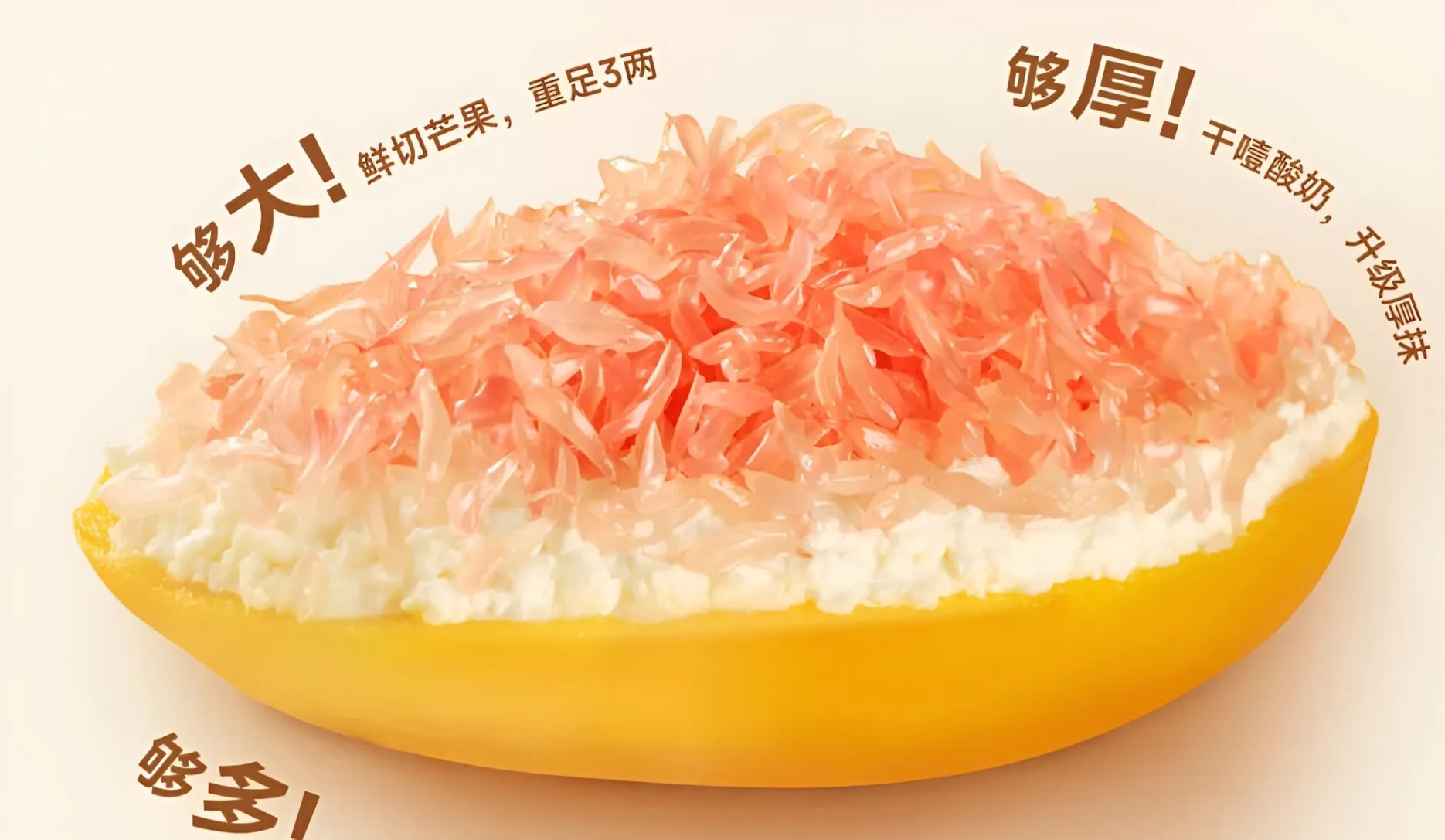
If you’ve been detoxing from social media recently you might have missed the trend that’s swept across Douyin (Chinese TikTok), Rednote and Weibo like a prairie fire. It’s solid mango pomelo sago (固体杨枝甘露)– a twist on a Cantonese dessert that’s been transformed into something of an architectural challenge: stacked, wrapped, skewered, rolled, stretched and overfilled to the point of parody.
On Xiaohongshu, content tagged solid mango pomelo sago passed 100 million views. On Douyin, related videos neared the one-billion-play mark. From Haidilao to China’s myriad tea chains, businesses have jumped on the trend.
From Cantonese staple to social spectacle

Sago, known locally as yangzhi ganlu (杨枝甘露), is a dessert of thin cream, diced mango, and pomelo, and dottings of tapioca balls, served in a bowl to be eaten with a spoon. Its solid cousin emerged when vendors began thickening the base with yoghurt and cream cheese, turning it into something that could be unmoulded, layered and picked up.
The shift from bowl to block unlocked everything that followed. Once the dessert could hold its shape, vendors stacked it into towers, wrapped it in durian flesh, skewered it like tanghulu, rolled it like a towel cake, or compressed it until it bulged out of plastic wrap. The appeal was visual excess, rather than flavour innovation.
Solid mango pomelo sago landed neatly inside a healthy-but-not-really paradox. Yoghurt and fruit signalled wellness. Portion size said the opposite. That contradiction made it sharable, tongue-in-cheek, and algorithm-ready – in short, an edible meme.
Who capitalised on the solid mango pomelo sago trend?

Dingdong Maicai
Fresh grocery platform Dingdong Maicai (叮咚买菜) moved first at scale. As solid mango pomelo sago videos took off, the platform saw yoghurt sales jump more than 400%, with daily sales volumes exceeding 10,000 units at the peak.
More importantly, Dingdong productised the trend. Within 24 hours, it launched DIY ingredient kits bundled around the dessert: yoghurt, mango, pomelo and sago pre-portioned for home experimentation. This wasn’t about selling a finished product. It was about enabling participation.
By treating virality as demand forecasting rather than noise, Dingdong turned a social trend into a meaningful product and positioned itself as infrastructure for internet food rather than a passive retailer.
Tea chains: fast remix over brand purity

Regional tea and dessert chains followed quickly, bolting solid mango pomelo sago variants onto existing menus. The winning executions didn’t over-engineer. They kept the base close to the viral original, oversized the portions, and leaned into visual mess rather than polish.
This mattered. Brands that tried to refine the dessert into something neater saw less traction than those willing to exaggerate. The algorithm rewarded maximalism. Chains that understood this treated the dessert as a temporary content prop priced for impulse, designed for filming, and expected to burn hot and fade fast.
Haidilao: meme adoption, not menu innovation
Haidilao’s (海底捞) involvement was less about dessert and more about signalling. Diners began assembling their own solid mango pomelo sago using the hotpot chain’s yoghurt, fruit and condiments. The staff didn’t stop it. They leaned in. And that was all the brand needed to do.
Videos of self-made versions inside Haidilao dining rooms spread rapidly, reinforcing the chain’s long-standing reputation as a permissive, user-driven space. No official product launch was required. That the meme existed inside the brand ecosystem was enough.
What can be learnt from the solid mango pomelo sago craze
The solid mango pomelo sago craze is a reminder that virality in China’s food economy rarely rewards originality. It rewards responsiveness. The brands and platforms that benefitted most didn’t invent the dessert, refine it, or even formally brand it. They removed friction. Grocery platforms enabled DIY participation. Flexible vendors oversized and exaggerated. Spaces like Haidilao allowed meme behaviour to happen inside their walls without intervention.
Two lessons stand out. First, format now matters more than flavour. A food’s ability to be filmed, remixed and exaggerated can outweigh taste or longevity. Second, speed beats authorship. By the time a perfect SKU is launched, the trend has usually moved on. Solid mango pomelo sago will fade. The mechanics that propelled it will not. For brands operating in China, the challenge isn’t predicting the next viral product, it’s about building systems that can respond fast, then step aside while the internet does the rest.