



Chinese manufacturing dominance: Key takeaways
- China’s manufacturing advantage is shifting from cheap labour to automation, engineering expertise and deeply connected supply chains
- AI could strengthen that advantage, but smarter factories still need demand: producing more does not guarantee profitable growth
- China could expand its influence by exporting machinery and manufacturing expertise, alongside finished products
In the 90s and early 2000s Made in China was stamped across anything cheap and mass produced. The label filled western clothing rails with fast fashion. Families ran on the help of inexpensive white goods. As a child, it kept me well-stocked in cheap toys.
For that era of Made in China, I wasn’t old enough to consider economics. Those that were assumed Chinese wages would eventually increase and the market would find a new place for production on the cheap. That would be the end of China as a manufacturing power.
What the country has learnt in the decades since the turn of the century has set it up to become a manufacturing hub of a very different kind
The assumption lasts, as does the perception that all China makes is cheap and low quality. But what the country has learnt in the decades since the turn of the century has set it up to become a manufacturing hub of a very different kind, and one that will not easily be dislodged by market forces.
The factory becomes the next AI frontier
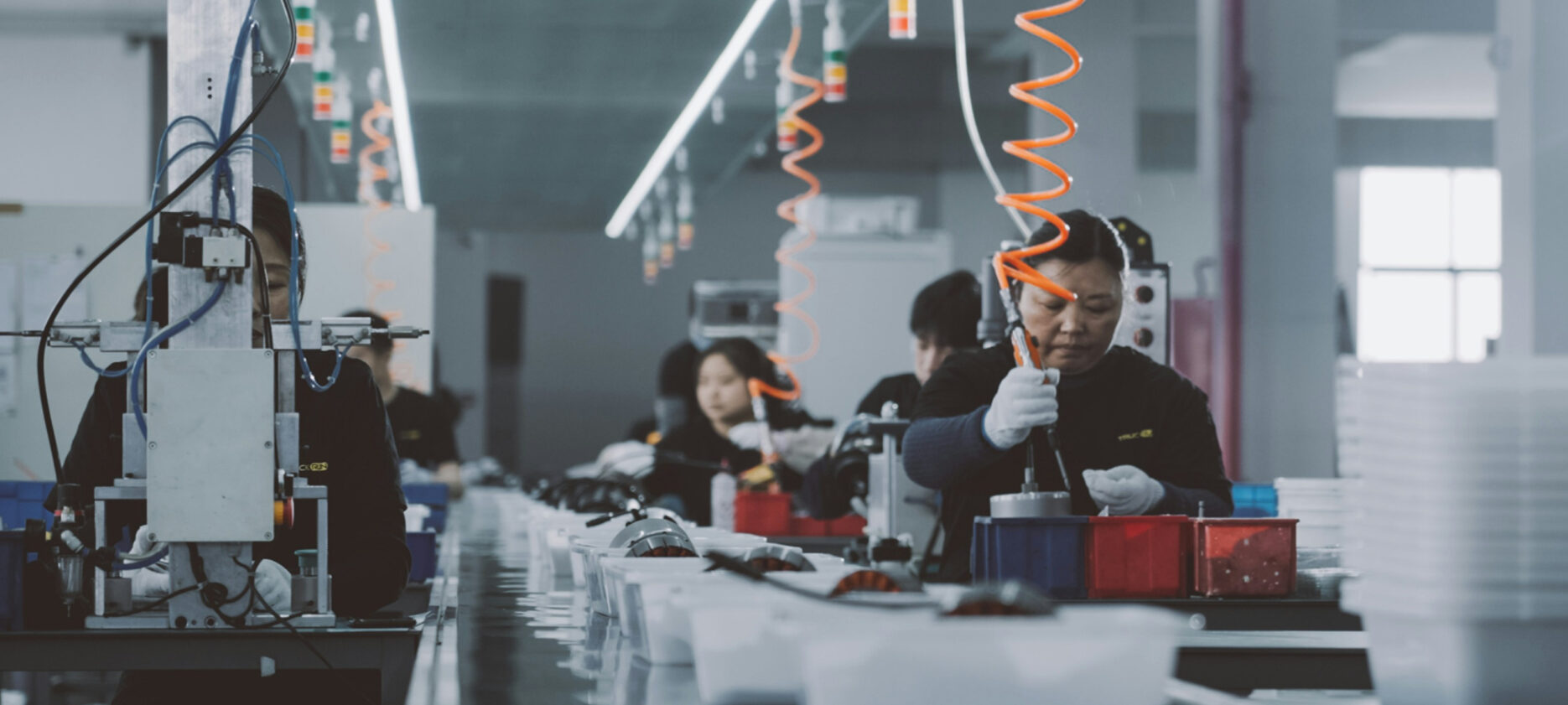
China’s factories of today are very different to the ones of old. They are high-tech and highly automated, producing very complex products like EVs, renewable energy systems and advanced batteries. China even manufactures the kind of tech that powers manufacturing this advanced.
Morgan Stanley estimates that China could invest up to $12 trillion through 2035 in infrastructure, factory upgrades and new industrial capacity. Its outlook envisages AI coordinating production, predicting maintenance needs and adjusting factory operations in real time.
These are expectations for an emerging industrial model, rather than a description of every Chinese factory today. But looking at what’s happening today doesn’t dampen China’s prospects either
High-tech manufacturing value rose 13.3% year on year in the first half of 2026, sending tech company profits flying by over 54%. Plus, China is beginning to pull away in global tech. 65% of the world’s EV batteries have the Made in China stamp, and over half of all industrial robots installed on Earth have it too. Interestingly, the old manufacturing base matters a lot to these industries.
Because China has been producing for the world, its engineers run into factory problems – and solve them
China’s massive manufacturing scale and its tight supply chains produced strong engineering talent in its time at the low end of manufacturing. Then there’s the feedback loop. Because China has been producing for the world, its engineers run into factory problems – and solve them – more regularly, and faster than anyone else.
Ultimately, China’s industrial legacy leaves it with a wealth of practical expertise. As cheap labor fades, automation and productivity-boosting tech have become the new gold mine.
Smart factories still need customers
Am I being over optimistic? Maybe. Even the smartest factory still needs customers. Nor can a more efficient factory create demand itself. If businesses use better technology mainly to produce more of the same goods, productivity gains could disappear into another round of price competition.
The decisive question is what reaches the consumer. Does improved Chinese manufacturing mean a more reliable appliance, a better car or a genuinely useful product?
One possible future sees China exporting its manufacturing – not the procucts of it – to other countries. Overseas factories could become dependant on on Chinese machinery and technical support. For Chinese businesses, supplying those capabilities could open another route to international growth.
A different kind of Chinese manufacturing power
Could is the operative word there. This technology creates possibilities but it doesn’t guarantee industrial leadership. We can say something with a degree of certainty though, and that’s that China’s position as the world’s manufacturing base is far from over.
No longer reliant on providing cheap labour, China is changing its approach to global production. And by trading manual assembly for artificial intelligence and automation, it ensures its industrial crown remains secure. The Made in China stamp has evolved from a mark of cheap affordability into a baseline for global technological dominance.