



Colgate (高露洁), surely one of the world’s most recognisable oral-care brands, has been swept into a truly bizarre controversy after a livestream promotion appeared to suggest that the toothpaste could do the impossible: make teeth ‘grow back’ and close gaps.
- On Weibo, the hashtag questioning Colgate’s claims (高露洁称能填上牙缝是过度宣传吗#) drew more than 13 million views.
The controversy centres on animated clips used by a verified livestream account used to sell Colgate products in China. The visuals promoted the brand’s 360° Anti-Sensitivity Repair Toothpaste, showing tooth gaps narrowing, damaged enamel being replaced, and dental issues seemingly recovering. The message leaned heavily on scientific-sounding language, framing the effect as ‘fluorapatite generation.’ It even went as far as comparing it to biological regeneration seen in animals – think lizards and their tails.
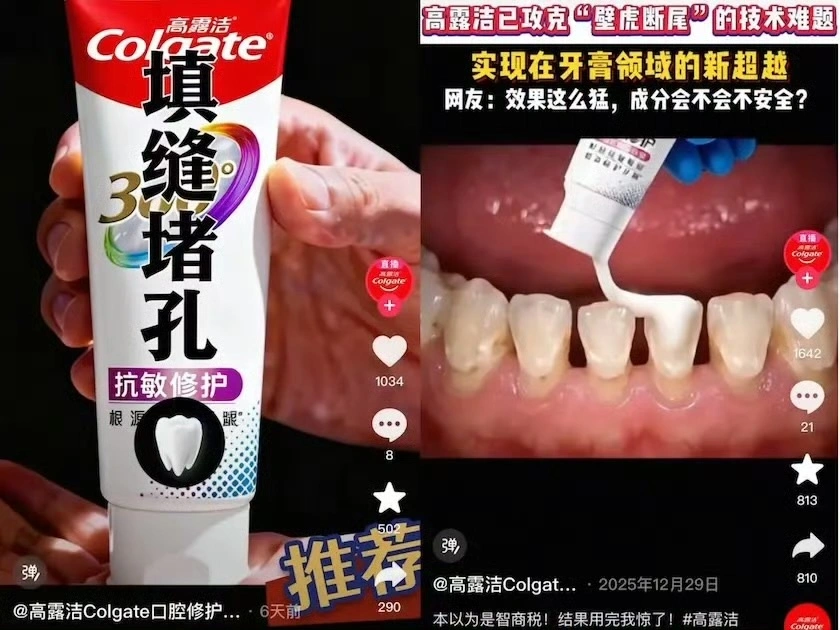
Dental professionals were quick to push back. Fluoride, they noted, has long been used to strengthen enamel and slow decay, but it cannot regenerate teeth, alter tooth structure, or physically close gaps. China’s National Medical Products Administration has also repeatedly clarified that toothpaste cannot legally claim functions such as cavity repair, gap filling, or stabilising loose teeth – placing the campaign on shaky regulatory ground.
The issue got even more bizarre when a blogger accused the brand of misusing his content. He claimed that footage he posted last year documenting a cosmetic dental procedure using veneers was edited and repurposed in Colgate’s livestream. According to the blogger, the video was altered with an AI-generated voiceover and enhanced visuals, transforming a clinical treatment into supposed proof of toothpaste efficacy.
The livestream account involved is reportedly authorised by Colgate-Palmolive China, rather than an impersonator channel. As of Chinese media’s latest reports, no formal public response has been issued.
On Weibo, the hashtag discussing the Colgate controversy drew more than 13 million views. The dominant tone was not fury, but disbelief. For many users, the episode underscored a broader shift: in China’s hyper-accelerated livestream economy, legacy brand authority no longer guarantees trust. When visual storytelling races ahead of scientific reality, even household names can find their credibility eroding in real time.