



In late March, the Australian skincare label is bringing its travelling Aesop Women’s Library (伊索女性文学图书馆) project back to two Chinese cities: Chongqing and Wuhan. It’s a move they’ve played before in Shanghai, Guangzhou, and other cities globally – and it’s a cool one. They pick a retail space, take products off the shelves and replace them with books. The result is a shop turned cultural centre, and a space for readers to explore women’s writing through talks, book giveaways and small-scale literary events.
For this iteration, nine women from different professional backgrounds will serve as guest speakers, known as Reading Leaders (flashbacks to primary school anyone?). The lineup includes media professional Xue Jian (薛剑), film scholar Dai Jinhua (戴锦华), academic Teng Wei (滕威), writer Yao Emei (姚鄂梅), scholar Huang Xiaodan (黄晓丹), artist Xiang Jing (向京), scientist Liu Ying (刘颖), theatre director Yang Ting (杨婷) and landscape designer Tang Ziying (唐子颖). They’ll be discussing how women express themselves across fields ranging from academia to art.
But it wouldn’t be a savvy China marketing move without a little localisation. And so, a new element is being introduced: an offline discussion series titled A Tea Room. Instead of traditional author talks, the Reading Leaders will reflect on the books that shaped their thinking and creative work. The idea is to move literary conversation out of traditional formats and into a place that can be engaged with on a more personal level.
Aesop Women’s Library: Why books?


For Aesop, literature has long been part of the brand’s identity. The company regularly references philosophy, poetry and essays across its packaging, stores and marketing. The Women’s Library project takes that connection a step further by transforming retail space into a temporary cultural venue, and one that reflects the literary side of the brand’s story.
The idea dates back to 2008 – back when Aesop cleared the shelves of two Melbourne stores and replaced them with around 8,000 books that customers could take home for free. What began as an experiment and a gesture has since evolved into a travelling stunt gone global.

In China it was a big hit. Those previous editions in Shanghai and Guangzhou drew in hordes. They didn’t fail to gain that much-needed online traction either. As Jing Daily has it, the Shanghai activation generated more than 2.45 million views on Xiaohongshu, turning the literary project into a widely shared cultural moment.
That mix of offline intimacy and social media traction is exactly what makes the idea work in China’s retail landscape. A bookstore pop-up might sound niche, but it offers something brands increasingly struggle to create: a physical space people actually want to linger in.
Retail without retail
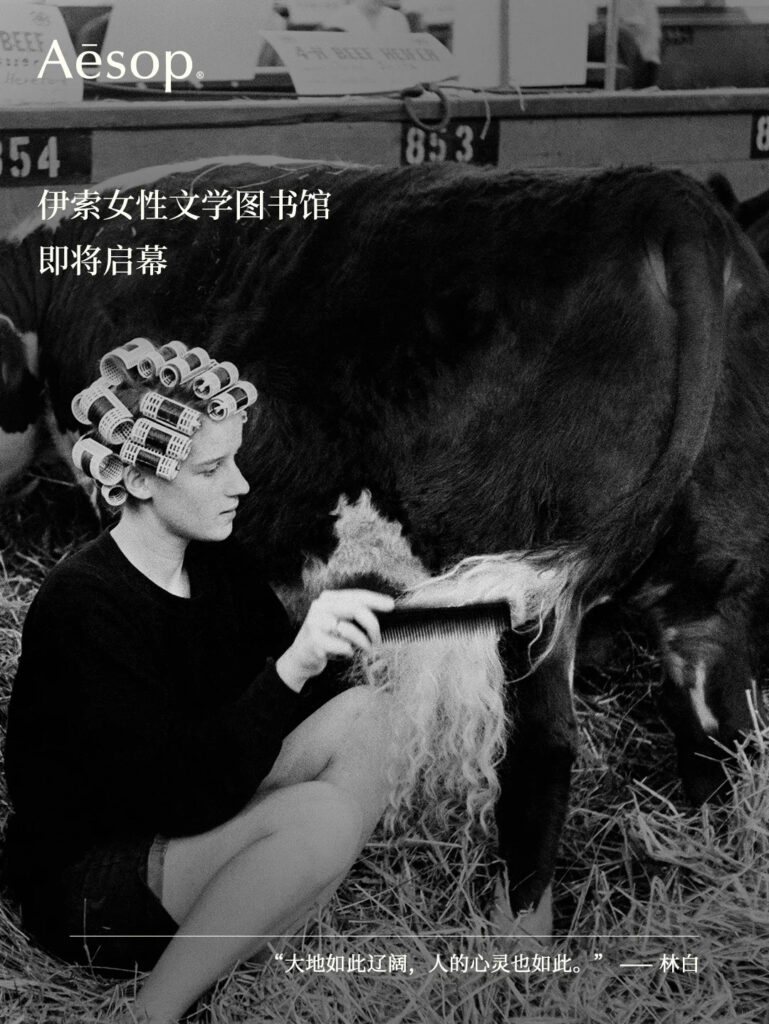
The activation flips the usual retail logic. Instead of pushing product, Aesop temporarily removes it. Visitors aren’t expected to buy anything – they might even leave with a free book. It’s restraint as strategy.
While heaps of brands out there are turning to a coffee machine or a gait check to increase dwell time, Aesop is saying ‘to hell with it, just come and hang out.’
By briefly doing away with consumerism, the brand can be candid about its cultural positioning. There’s no feeling that the philosophy and literature message is just a PR stunt. Doing so builds real, meaningful engagement and gives people a reason to spend great lengths of time in the space. While there, they might even shop.