




After a decade on one of China’s busiest retail streets, MUJI is closing the doors of its Shanghai flagship store at 755 Huaihai Middle Road. The store, which opened as the Japanese brand’s first flagship in China, will officially shut at the end of March, marking the end of an era for a space that helped introduce many Chinese consumers to MUJI’s vision of minimalist living.
MUJI says the closure of its Huaihai Road flagship is part of an adjustment to its retail network rather than a pull-back from the China market. The company has been reshaping its store footprint, closing some older locations while planning to open dozens of new ones nationwide. But true to a brand synonymous with good taste, they’ve managed to make tis pull-out of a prime location into an artfully smooth exit.
How did MUJI spin the closing of its Shanghai flagship?
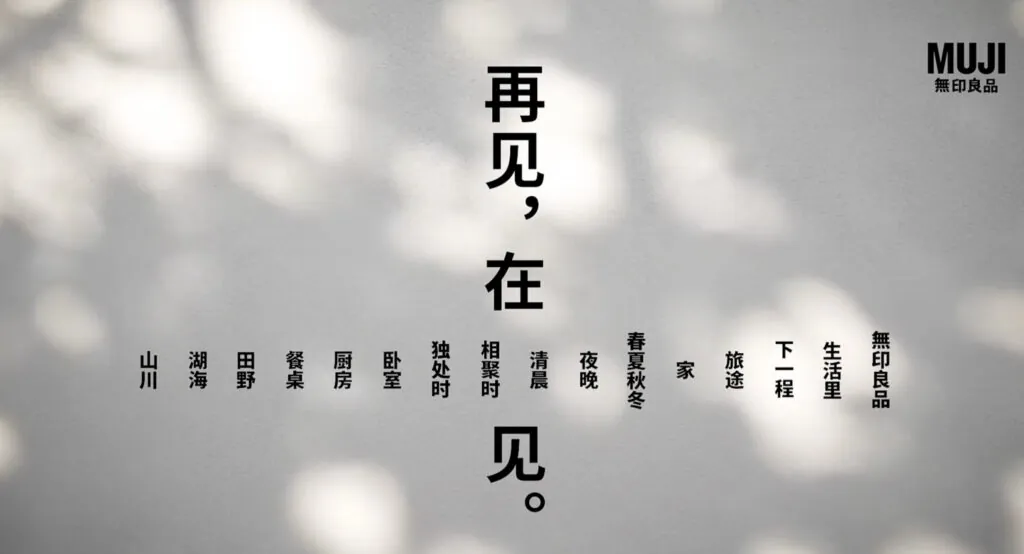
Rather than launching the typical closing sale spectacle, MUJI has chosen something far more in character with that vision of minimalism: a quiet goodbye. On the exterior wall of the store, the brand installed a large farewell poster, bold print stating: goodbye, see you again (再见,在见) employing a Chinese linguistic twist. While 再见 literally means ‘goodbye,’ it can also be read as ‘see you again.’ The dual meaning puts a softer spin on the departure. It’s not a forever goodbye.
The visual language also follows that stylistic restraint. Sparse typography sits against areas of blank space, while the copy inserts everyday scenes between the characters ‘在’ (to exist) and ‘见’ (to meet).


Mountains, lakes, fields and dining tables appear alongside moments such as solitude, gatherings, mornings and nights. The message reframes the brand’s relationship with customers not as a retail transaction, but as a series of small encounters woven through daily life. MUJI also released a short film to accompany the campaign. Set against shifting natural light and tree shadows, text slowly emerges on screen, creating a gentle, almost meditative rhythm.
MUJI’s other great moments


The approach echoes MUJI’s long-standing visual style. From the brand’s famous ‘Horizon’ poster series – which featured vast landscapes with barely any product visible – to lifestyle campaigns around MUJI Hotel and Found MUJI exhibitions, the company has consistently relied on minimalist imagery and reflective copy rather than overt advertising.
The farewell campaign for the MUJI Shanghai flagship closure hits on the brand’s broader storytelling strategy in China too. Last year, during the renovation of its Chengdu Taikoo Li flagship, MUJI launched a poster series titled ‘川流有息’ (Lit. Flowing endlessly, with moments to breathe), using poetic copy grab attention, and touch on that sense of soothing the brand’s message pushes.
Muji’s Shanghai flagship closure: not goodbye
The closing of the Huaihai Road flagship says as much about China’s evolving retail landscape as it does about MUJI itself. Large flagship stores like the Huaihai site are expensive to operate, and shifting shopping habits – from the rise of e-commerce to changing foot traffic patterns in traditional shopping streets – are forcing brands to rethink how physical retail fits into the wider customer journey.
Instead of treating the closure as a dry commercial announcement, MUJI turned it into another chapter of its storytelling and a reminder that the brand’s idea of good living was never confined to a single storefront. And so it’s got to be said: that was one smooth exit.