



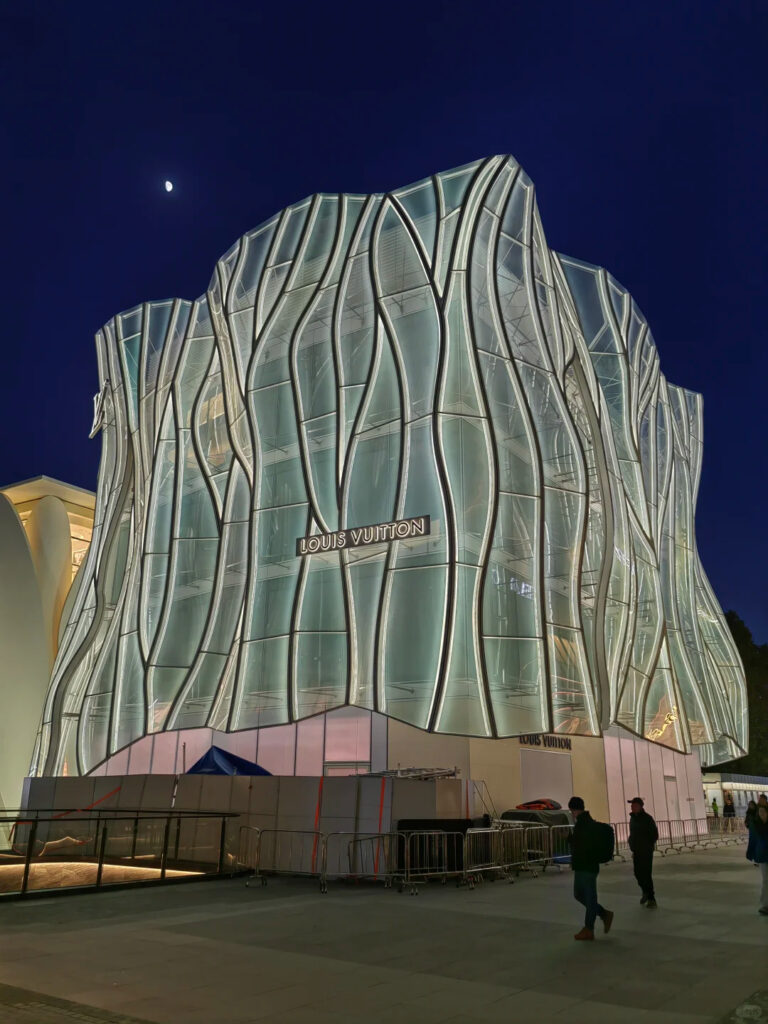
Louis Vuitton (路易威登) has unveiled a Beijing flagship, the Maison Louis Vuitton Sanlitun, positioning it as both an architectural statement and a new cultural destination in the capital. Opened on December 19, the building is designed by Japanese architect Jun Aoki, a long-time collaborator of the house whose past projects include Louis Vuitton landmarks in Tokyo and Osaka.
In Beijing, Aoki’s approach blends local cultural reference with fashion-led spectacle. This comes in the form of Taihu stone (太湖石) – the porous scholar’s rocks found in classical Chinese gardens – and the display of a silver dress designed by Nicolas Ghesquière for Louis Vuitton’s Spring–Summer 2016 womenswear show.
Behind the facade, the store unfolds across four levels. A central atrium connects the women’s spaces over three floors, alongside four private lounges for VIP clients. The third floor houses a dedicated Louis Vuitton Home space, showcasing furniture, tableware and textiles, including collections by Patricia Urquiola and Cristian Mohaded.
The fourth floor introduces a first for the brand in Beijing: Le Café Louis Vuitton. Designed as an immersive dining experience, it features a mirrored ‘infinite room,’ a main dining space with a terrace overlooking Sanlitun, and a private VIP room. The menu combines house classics with localised creations, from lobster rolls to jiaozi-inspired dishes and a hawthorn-flavoured dessert developed specifically for China.

The opening also lands at a moment when global luxury brands are recalibrating their China strategies. As foot traffic growth slows and consumers become more selective, flagships like Maison Louis Vuitton Sanlitun are increasingly designed to function as destinations rather than pure retail spaces.
Architecture, food and cultural programming are being used to extend dwell time, reinforce brand narrative and anchor relevance, often in key urban markets like Beijing and Shanghai. In this context, Maison Louis Vuitton Beijing reflects a wider shift: from transactional shopping to experiential brand immersion, where stores double as social, cultural and lifestyle landmarks.